The corridor
The corridor is the low-ceilinged, cellar-like passage in the Castle Inn where the castle's secretaries and officials conduct their nocturnal hearings and where K. experiences some of his most disorienting encounters with the castle's bureaucracy. It is a space of enforced waiting, accidental intrusion, and the revelation of the officials' peculiar sensitivities, ultimately serving as the stage for K.'s failed attempts to gain access to Klamm and his humiliating expulsion from the inn's inner sanctum.
Physical Description and Location
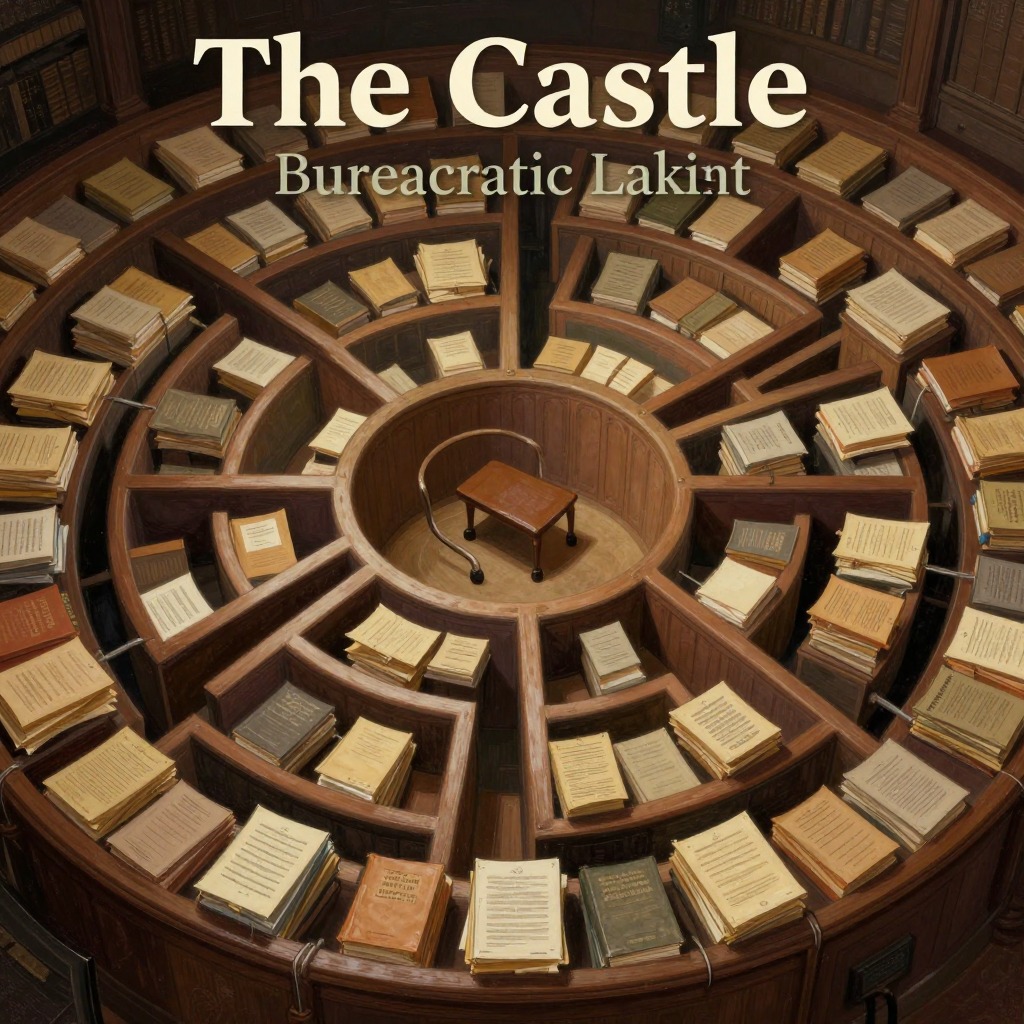
The corridor is a narrow, low-ceilinged passage that runs through the Castle Inn, accessible from the yard through a gate. It is described as "low-ceilinged but apparently long," with a staircase turning at right angles leading up from it. The walls do not reach all the way to the ceiling, a design intended for ventilation, since the little rooms off the corridor have no windows. This gap at the top of the walls makes the corridor and the rooms noisy, as sounds carry easily. The corridor is lit by bright electric light, and the rooms are built on a small scale but delicately designed, with door after door opening off the sides, all close to each other. The best possible use is made of the space, and one can only just walk upright along it. The corridor is part of the inn's private quarters, where the higher-ranking officials stay on the upper floors, while the secretaries' rooms, even those of important figures like Erlanger, lie off this lower passage.
The Corridor as a Site of Waiting and Exclusion
The corridor is primarily a place of waiting, where members of the public are kept before their hearings. K. first encounters this when he is summoned to see Erlanger and is told to wait outside his room. The corridor is also where the landlady of the Castle Inn, in her "neurotic striving for refinement," forces members of the public to wait outside in the snow rather than in the corridor, a practice that K. observes with disapproval. The corridor is thus a liminal space, neither fully inside nor outside the inn, where the castle's authority is felt through the control of access and the imposition of waiting.
K.'s Encounters in the Corridor
K.'s most significant experiences in the corridor occur during his nocturnal visit to the Castle Inn. After being summoned by Erlanger, he wanders the corridor, accidentally entering the room of Bürgel, a communications secretary, where he falls asleep and misses the opportunity that Bürgel describes. Later, he encounters Frieda in the corridor, who has left him for Jeremias, and he tries to win her back. The corridor is also where K. is confronted by the landlord and landlady, who scold him for lingering in the corridor in the morning, an act that they claim has disturbed the officials' sensitive morning routine. This confrontation leads to K.'s expulsion from the inn's inner areas.
The Corridor's Role in the Bureaucratic System
The corridor is integral to the castle's bureaucratic operations. It is here that files are distributed to the officials in the morning, a process that K. observes with fascination. The distribution is a complex and often chaotic affair, with servants negotiating with officials through the gaps above the doors. The corridor is also where the officials' nocturnal hearings take place, a practice that Bürgel explains in detail. The corridor thus embodies the castle's paradoxical nature: it is a space of intense activity and communication, yet also of isolation and inaccessibility, where officials remain hidden behind closed doors and members of the public are kept at a distance.
The Corridor as a Symbol of K.'s Failure
The corridor ultimately symbolizes K.'s failure to penetrate the castle's inner workings. His attempts to use the corridor to gain access to Klamm or to assert his presence are thwarted at every turn. He is told that he has no right to be in the corridor, that he should have left immediately after his hearing, and that his lingering has caused great offense. The corridor, with its closed doors and hidden officials, represents the unbridgeable gap between K. and the castle, and his expulsion from it marks a low point in his quest. The corridor is thus a microcosm of the novel's central theme: the individual's struggle against an incomprehensible and indifferent bureaucracy.